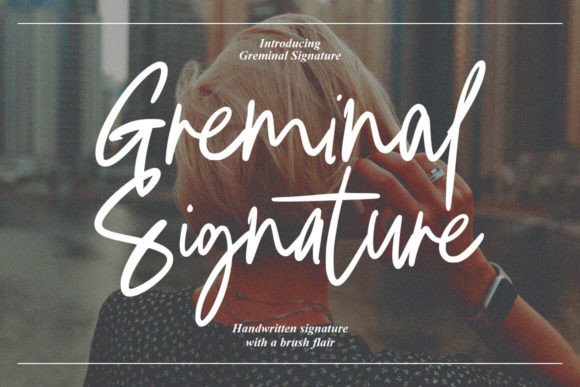
Greminal Signature: A Handmade Style for Elegant Typography
Greminal Signature is a unique font designed to emulate the look of handwritten signatures, offering a personalized and artistic touch to any design project. Its handmade aesthetic, combined with decorative characters and a dancing baseline, makes it particularly well-suited for invitations, greeting cards, branding materials, business cards, quotes, posters, and more. The font’s distinct style allows designers to add a sense of authenticity and elegance to their work without the need for actual handwriting.
What Makes Greminal Signature Distinct?
The standout feature of Greminal Signature is its signature-style design, which mimics the fluidity and irregularities of real handwritten text. Unlike standard fonts that follow strict geometric forms, this typeface embraces the natural variations found in human script. The result is a visually engaging and expressive font that feels personal and dynamic.
A key element of Greminal Signature is its use of decorative characters. These include flourishes, ornamental strokes, and other stylistic elements that enhance the visual appeal of the text. The font also features a dancing baseline, meaning that the lines on which the letters sit are not perfectly straight but instead have subtle undulations. This adds a sense of movement and liveliness to the typography, making it ideal for creative projects that require a more artistic approach.
The font comes with 250 glyphs, providing a wide range of characters and symbols. This extensive set ensures that users can find the right character for most typographic needs, whether they're working on a simple logo or a complex layout.
OpenType Features for Enhanced Customization
Greminal Signature includes a variety of OpenType features that allow for greater customization and flexibility. These features are organized into categories such as Swash, Stylistic Sets, Stylistic Alternates, and Ligatures. Each of these options provides different ways to modify the appearance of the text, giving designers more control over the final look.
- Swash: Adds decorative extensions to certain letters, often seen in calligraphy styles.
- Stylistic Sets: Offers predefined sets of alternative characters that can be applied to entire words or phrases.
- Stylistic Alternates: Provides individual alternate versions of specific characters for more nuanced adjustments.
- Ligatures: Combines certain letter pairs into a single glyph, improving readability and aesthetics in some cases.
These OpenType features can be accessed using software that supports them, such as Adobe Illustrator, Adobe InDesign, Adobe Photoshop, CorelDraw X version, and Microsoft Word. This makes Greminal Signature versatile across different design platforms and workflows.
PUA Unicode for Easy Access to Alternate Characters
In addition to OpenType features, Greminal Signature includes a PUA (Private Use Area) Unicode encoding. This means that all alternate characters are available without relying on specific software support. For designers who work in environments where OpenType features may not be fully supported, the PUA encoding ensures that every variation of the font remains accessible.
This feature is especially useful for those who want to maintain consistency across different applications or who prefer a more straightforward method of accessing alternate characters. It also simplifies the process of integrating Greminal Signature into projects that may not require advanced typographic controls.
Comparing Greminal Signature with Similar Fonts
When considering Greminal Signature, it's helpful to compare it with other fonts that offer similar styles. While many scripts and handwritten fonts aim to replicate the look of cursive writing, Greminal Signature stands out due to its focus on signature-style typography. This makes it more suitable for projects that require a personal or artistic touch rather than a traditional script.
Fonts like Brush Script or Zapfino also offer a handwritten feel, but they tend to be more uniform in their design. Greminal Signature, by contrast, introduces more variation and spontaneity, which can be both an advantage and a challenge depending on the project’s requirements.
Another consideration is the availability of OpenType features. While some fonts provide limited access to stylistic alternatives, Greminal Signature offers a comprehensive set of options through both OpenType and PUA encoding. This gives designers more flexibility when working on intricate layouts or custom designs.
Best Fit Situations for Greminal Signature
Greminal Signature is ideal for projects that benefit from a handmade or artistic aesthetic. It works well in situations where the goal is to convey a sense of individuality, creativity, or personal expression. For example, it can be used to create elegant wedding invitations, custom business cards, or branded merchandise that requires a unique visual identity.
The font is also a good choice for designers who want to add a touch of sophistication to digital artwork, social media graphics, or print materials. Its decorative elements and dynamic baseline make it stand out in a way that more rigid fonts cannot achieve.
However, it's important to note that Greminal Signature may not be the best option for all projects. In cases where clarity and legibility are paramount, such as in body text for long-form documents or user interfaces, a more structured font might be more appropriate. The font’s stylized nature can sometimes make it less readable at smaller sizes or in dense text blocks.
Limitations and Tradeoffs
While Greminal Signature offers a distinctive look, it does come with some limitations. One of the main tradeoffs is its suitability for different contexts. Because of its decorative and flowing style, it may not be ideal for formal or professional settings where a more conventional font would be expected.
Additionally, the font’s complexity can sometimes lead to inconsistent spacing or alignment issues, especially if not properly adjusted. Designers should be mindful of how the font interacts with other elements in their layout and may need to fine-tune the spacing or line height for optimal results.
Another factor to consider is the level of technical expertise required to fully utilize the font’s features. While the PUA encoding simplifies access to alternate characters, understanding how to effectively use OpenType features may require some familiarity with design software and typographic principles.
When Greminal Signature Is the Right Choice
Greminal Signature is the right choice when the goal is to create a visually striking and expressive design. It excels in projects that emphasize artistry, personalization, or a unique visual identity. For instance, it can be used to design custom quotes, motivational posters, or branding materials that require a handcrafted feel.
It is also a strong option for designers who want to experiment with different typographic styles and explore the possibilities of handmade-typefaces. Its combination of decorative elements, OpenType features, and PUA encoding makes it a versatile tool for creative professionals looking to add a special touch to their work.
Alternative Options to Consider
If Greminal Signature does not meet the specific needs of a project, there are alternative fonts that may be more suitable. For example, fonts like Lobster or Great Vibes offer a similar handwritten style but with a more consistent and structured appearance. These options may be better suited for projects that require a balance between creativity and readability.
For those who prefer a more minimalist or modern look, fonts like Playfair Display or Cinzel provide an elegant and sophisticated alternative. These fonts are often used in high-end design projects and can complement a wide range of visual styles.
Ultimately, the choice of font depends on the specific goals of the project, the target audience, and the overall design vision. Greminal Signature is a powerful tool for those seeking a handmade, decorative, and expressive typeface, but it’s important to evaluate all options before making a final decision.